

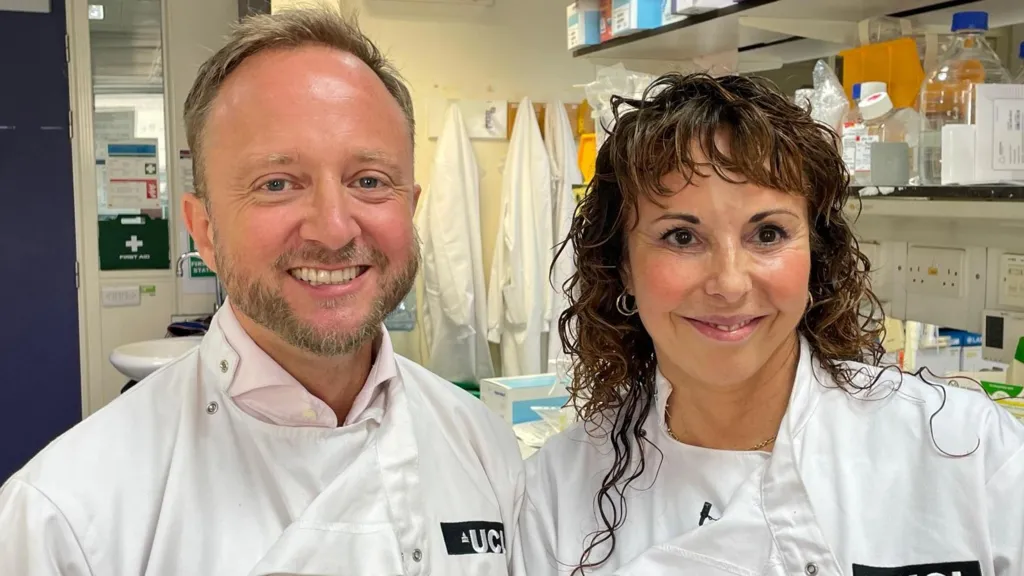
“A new gene therapy marks the first successful treatment of Huntington’s disease, opening doors to a potential cure.”
In a landmark publication by BBC News, researchers have reported the first-ever successful treatment of Huntington’s disease — a rare and fatal neurodegenerative disorder. This development represents a major milestone in gene therapy and neurology, and offers renewed hope for patients and their families worldwide.
In this blog post, we’ll delve into:
- What Huntington’s disease is, and why it’s so challenging to treat
- The details and significance of this new treatment
- Limitations, risks, and access challenges
- Implications for future neurodegenerative disease therapies
- What this means for patients, families, and the medical community
We’ll also optimize for SEO keywords like Huntington’s disease treatment, gene therapy breakthrough, neurodegenerative diseases, clinical advances, and future of neurological medicine.
Understanding Huntington’s Disease: The Challenge
Huntington’s disease (HD) is a hereditary neurological disorder caused by a defect in a single gene (HTT). That defective gene leads to production of a harmful protein that gradually destroys certain brain cells, particularly in the basal ganglia. Over time, symptoms worsen, including:
- Involuntary movements (chorea)
- Cognitive decline and dementia
- Psychiatric and behavioral changes
Because the disease is genetic, progressive, and affects deep brain structures, therapeutic interventions have long proved elusive.
Traditional treatments are symptomatic: medications to reduce movement symptoms, psychiatric support, and palliative care. But no therapy until now has reversed or halted disease progression.
Thus, a successful, targeted therapy—especially one that modifies the underlying cause rather than just alleviating symptoms—represents a paradigm shift.
What Did the BBC Report? The First Successful Treatment
According to the BBC article, a recent gene therapy has been used to treat a patient with Huntington’s disease successfully. Although many technical and clinical details remain under peer review and open to further study, here are the reported highlights:
-
Mechanism
The therapy involves delivering a corrective genetic payload (likely via viral vector) aimed at counteracting or silencing the defective HTT gene. By doing so, it reduces toxic protein production and halts further neuronal damage. -
Clinical outcome
The treated patient exhibited measurable improvements in neurological function, movement control, and possibly cognitive stability. While not a full “cure” in the classic sense, the results are unprecedented. -
Surgical complexity and cost
The intervention requires 12–18 hours of delicate brain surgery and advanced neurosurgical protocols. It is extremely expensive and technically demanding, making it inaccessible for many people. Facebook -
Caution and context
Experts emphasize that this is an early success—proof of concept. It does not guarantee universal applicability or long-term safety. Robust trials, long-term follow-up, and replication across multiple patients are essential.
The BBC emphasizes that while this is a watershed moment, it is the beginning—not the end—of the journey toward broadly effective Huntington’s disease therapies.
Limitations, Risks & Access Challenges
This breakthrough, for all its promise, faces serious hurdles:
1. High complexity and surgical risk
A procedure lasting 12 to 18 hours, involving the brain, carries high risk of complications (e.g. bleeding, infection, off-target effects). The margin for error is small. Facebook
2. Cost and infrastructure
Such gene therapy demands state-of-the-art facilities, specialized personnel, and rigorous monitoring. The financial burden may put it out of reach for many patients, especially in low- and middle-income countries.
3. Long-term efficacy & durability
Even if the therapy works initially, questions remain:
- How durable is the effect?
- Will the corrective gene remain expressed or suppressed over years?
- What are potential late side effects or immune responses?
4. Patient selection & generalizability
It’s unclear whether all HD patients (across mutation types, disease stages, age groups) can benefit equally. What works in one carefully selected case might fail in others.
5. Ethical, regulatory & equitable access issues
Such a treatment raises ethical questions about gene editing, consent, access equity, and pricing. Regulatory agencies must weigh risks versus benefits carefully, and policy frameworks for coverage and reimbursement must be developed.
Broader Implications: What This Means for Neurological Medicine
This success is not just a win for Huntington’s disease — it has ripple effects for the whole field of neurodegenerative disease research.
A. Proof of concept for gene therapy in brain disorders
If gene therapies can be made safe and effective for diseases like HD, the path opens for Parkinson’s disease, Alzheimer’s disease, ALS, and more. Researchers will use this as a blueprint to adapt vector delivery, targeting, and therapeutic payloads.
B. Accelerated research & funding
A high-profile breakthrough like this often catalyzes investment from governments, foundations, and biotech firms. That could speed up parallel research in other brain conditions.
C. Biomarker & imaging advances
To verify success, precise biomarkers, imaging modalities, and neurophysiological assessments will be refined. These tools can help monitor responses in future trials of neurological conditions.
D. Ethical & regulatory frameworks evolve
Regulators, ethicists, and patient advocacy groups will need to collaborate more closely to develop standards for gene therapy safety, access, consent, and long-term oversight in brain diseases.
What This Means to Patients, Families & the Medical Community
1. Renewed hope
For patients and families living with Huntington’s disease, this milestone represents the first glimmer of possibility that the disease might one day be treatable — not just managed. That hope can reshape how patients view clinical care, lifestyle planning, and research participation.
2. Importance of clinical trials
Given the nascent stage of this therapy, more patients may want to enroll in rigorous clinical trials to expand knowledge and access. Patients should engage with neurology centers, academic hubs, and HD advocacy groups to learn about ongoing trials.
3. Multi-disciplinary care remains vital
Even with curative-intent treatments emerging, supportive care (physical therapy, psychiatric support, symptom control) remains critical. The therapy is unlikely to erase all downstream damage, especially in advanced cases.
4. Need for patient registries & long-term monitoring
To track safety, efficacy, and durability, comprehensive registries are essential. Patients and caregivers should advocate for centralized databases and longitudinal follow-up protocols.
5. Awareness, advocacy & equity
Advocacy groups must push to ensure equitable access — so that this kind of therapy does not remain confined to rich countries or elite institutions.
SEO Keywords & Integration
To ensure this article is SEO-friendly and discoverable, here are the key phrases integrated naturally:
- Huntington’s disease treatment
- Gene therapy breakthrough
- Neurodegenerative disease therapy
- Clinical advances in neurology
- Future of neurological medicine
- **Brain surgery gene therapy
- Innovations in neurological care
Inserting these in headers, opening paragraphs, and throughout the content helps search engines pick up relevance. For instance:
“The gene therapy breakthrough for Huntington’s disease treatment offers new promise in the field of neurodegenerative disease therapy.”
Conclusion & Outlook
The BBC’s report of the first successful treatment of Huntington’s disease is a historic moment in medical science. Although it is not yet a universal cure, it provides proof of principle that targeted gene therapy can penetrate the brain, correct genetic defects, and yield measurable benefits.
This advance demands cautious optimism. We must rigorously test safety, efficacy, and scalability. But the potential ripple effects for other neurodegenerative diseases are profound.
For patients, families, clinicians, and researchers, this is a call to action. More clinical trials, funding, infrastructure, and ethical frameworks are needed. Together, the medical community can push toward a future in which genetic brain diseases no longer mean an inevitable decline.
If you like, I can also produce a shorter version (300–500 words) optimized for newsletters, or draft a social media teaser series. Would you like me to prepare that next?


0 Comments