

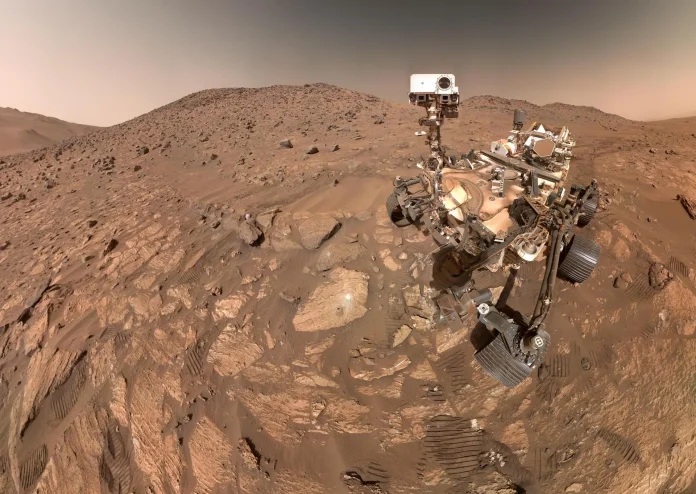
In an exciting development for astrobiology and space exploration, NASA’s Perseverance rover has discovered chemical signatures in Martian rocks that may be the most compelling hints yet of possible ancient microbial life. The evidence comes from rocks found in a dried-river channel on Mars, suggesting that parts of the Red Planet may once have been habitable environments capable of supporting life.
The Findings: What Perseverance Found
The rover was exploring Neretva Vallis, an ancient river channel that once fed into Jezero Crater. There, in the so-called Bright Angel Formation, which is rich in clay mudstones, scientists have identified organic carbon along with mineral deposits like iron phosphate and iron sulfide.
But the story doesn’t end with just chemistry. Visual features in the rock samples include microscopic “poppy seeds” and “leopard spots” – tiny patches or inclusions enriched with particular minerals. On Earth, similar textures and mineral enrichments are often associated with microbial activity—especially in extreme environments where life must adapt under harsh conditions, such as in cold, dry, or highly acidic settings.
Why These Clues Matter
These discoveries are significant for several reasons:
Organic Carbon: This is a central component in all Earth life; finding it in these rocks raises the possibility that life-friendly chemistry was present on ancient Mars.
Mineral Signatures: Minerals like iron sulfide and iron phosphate often form in the presence of water and can be products or by-products of microbial metabolism. Their presence strengthens the possibility that the conditions were right for life.
Ancient Water: Neretva Vallis is an old river channel, and Jezero Crater is known to have held water in the past. Habitable conditions usually require liquid water, so finding signs in this geological context increases the plausibility of ancient life.
Texture / Visual Clues: The “poppy seed” and “leopard spot” textures echo geological features on Earth that sometimes harbour fossilized microbial structures. While these are not proof, they provide morphological clues that support the chemical evidence.
Mission Progress & Challenges
Perseverance landed in Jezero Crater in February 2021 after launching in July 2020. Since then, it has collected dozens of samples—this particular sample is the 25th collected, with 30 overall so far. Additionally, there are 10 titanium tubes stored on Mars intended as backup.
One of the mission’s big goals is to return samples to Earth, where they can be analyzed in far greater detail than is possible remotely. Initially, NASA planned for a sample return by the early 2030s. However, rising costs—estimated now at USD 11 billion—have pushed that timeline later, possibly into the 2040s. NASA is also investigating more cost-effective and faster ways to bring these samples back.
The Implications
If the findings are confirmed to be biological in origin, they would be transformative. It would be the first direct evidence of life beyond Earth, rewriting textbooks and deeply influencing our understanding of what makes a planet habitable. It would also reinforce the scientific case for more human missions to Mars and could guide where and how those missions land and search.
On the other hand, even if future studies show that non-biological processes (geochemical reactions, for example) can produce the observed features, that too is valuable. It teaches us how Earth-like signatures may be generated in lifeless settings, helping scientists better avoid false positives in life detection.
Looking Ahead
There’s more work ahead: detailed analysis of the samples, comparisons with Earth analogues, refining the return mission plans, and possibly designing new instruments or missions specifically tuned to hunt for signs of life. Whether or not life is confirmed, this discovery marks a major step forward in Mars exploration.
For now, the message is that Mars might have been much more hospitable in its ancient past than we once thought—not just barren rock, but a place where life could have taken hold. Perseverance’s findings give us our strongest hints yet that somewhere under the Martian dust and rock, there could be a story of life waiting to be told.
Conclusion
NASA’s Perseverance rover has brought us closer than ever to answering one of humanity’s oldest questions: Are we alone? With organic carbon, mineral evidence, and ancient river geology working together, the possibility of ancient microbial life on Mars looks more plausible than before. While confirmation is still to come, these discoveries are milestones—markers that guide future missions and fuel our collective curiosity about the universe we inhabit.


0 Comments